
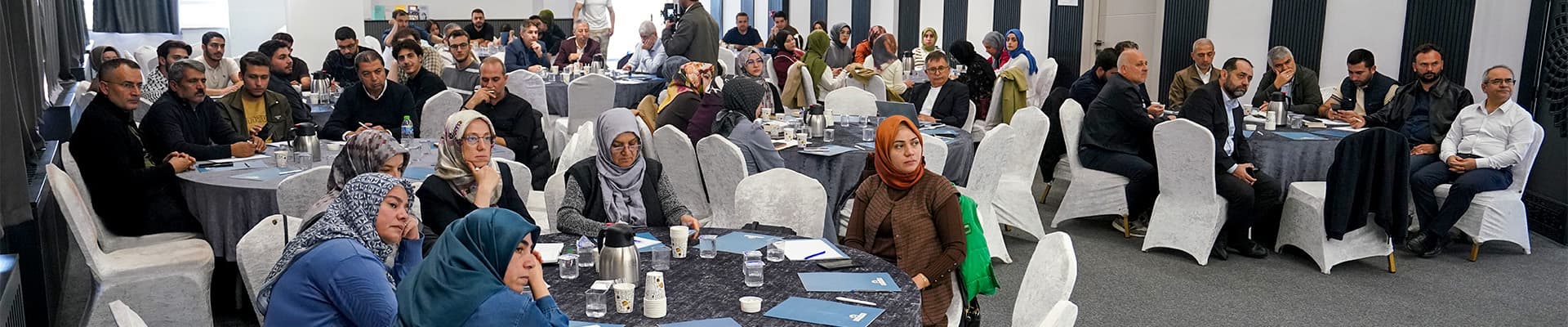
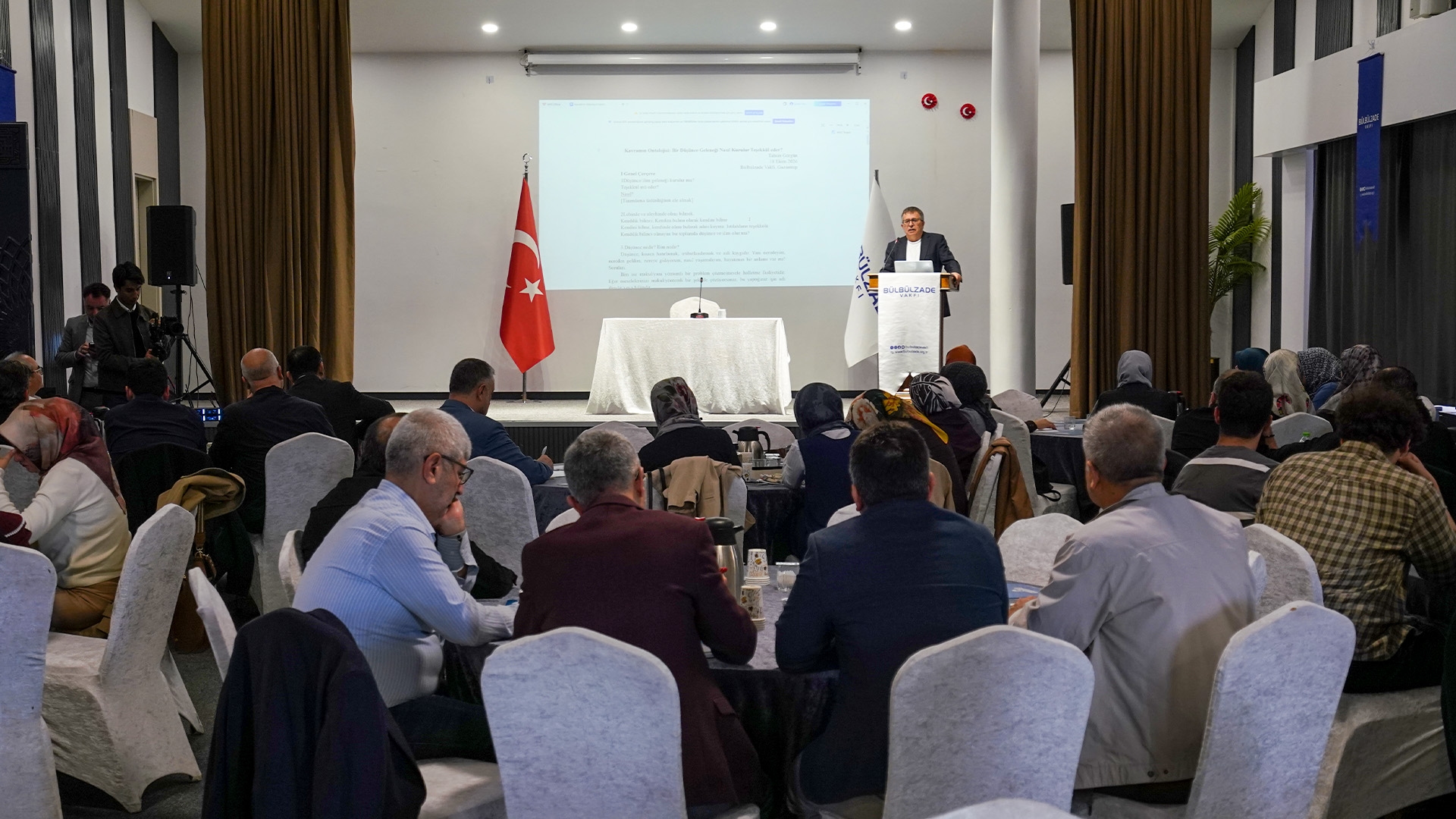
The 2nd Concept Workshop, organized by the Bülbülzade Foundation, brought together foundation volunteers and educators at Zade Life Hotel with the aim of rebuilding the intellectual framework of societies.
The second of the Concept Workshops organized by the Bülbülzade Foundation was held at Zade Life Hotel with high attendance. At the program, which attracted the interest of foundation volunteers, educators, foundation staff, and numerous guests, the concepts forming the foundation of our intellectual world were discussed. Focusing on the importance of societies finding their own language in the process of defining themselves and building the future, the workshop featured rich presentations and in-depth discussions. The program, shaped around the theme “The Ontology of Concepts: How Is a Tradition of Thought Established?”, addressed the establishment of a tradition of thought.
SOCIETIES THAT LOSE THEIR CONCEPTS LOSE THEIR WAY
In his opening speech, Bülbülzade Foundation President Turgay Aldemir emphasized the need to move forward with new concepts in a new era. Stating that they aim to rebuild the intellectual framework of societies, Aldemir said, “Concepts offer us a perspective that reveals how a society sees itself and how it reads and interprets the world. For this reason, as we also see throughout history, societies that lose their concepts lose their way.” Drawing attention to the characteristics that the language of civil society should embody, Aldemir continued, “The language of civil society needs to manifest itself as a language that aspires to transform society, is inclusive, assumes responsibility, and produces solutions.” Pointing to the importance of investing in ontology rather than physiology, Aldemir reminded participants of the necessity of building a new language that appeals to the hearts and minds of young people simultaneously.
HOW IS A TRADITION OF THOUGHT ESTABLISHED?
The main speaker of the workshop was author Tahsin Görgün, whose works are published under the Tire Kitap imprint. Leaving a profound mark on our intellectual world through his books, Görgün evaluated the historical process of Islamic civilization and Muslim societies within an ontological framework in his comprehensive speech at the workshop. In his thought-provoking analysis comparing Islamic and Western civilizations, Görgün highlighted how a tradition of thought is established.
THERE CAN BE NO CONCEPT WITHOUT KNOWLEDGE
Addressing the struggle for existence and historical stance of Muslims, Görgün said, “We Muslims, as an entire ummah, have gone through a great ordeal over the last 150 years. We are only now beginning to recover, and our greatest achievement is preserving our existence despite all these negative conditions.” Explaining that we need to understand the conditions of our own existence, Görgün pointed to the heart of the matter with the words, “We exist; what are our own categories of existence, and within which categories does our existence unfold? The answer to these questions lies in concepts.” Stating that the construction of concepts depends on self-awareness, the author observed, “A society that lacks self-awareness and is therefore deficient in making itself an object and source of knowledge cannot have its own concepts and terms.”
KNOWLEDGE AND THOUGHT CANNOT BE TAKEN FROM ANOTHER SOCIETY
Explaining the distinctiveness of Islamic civilization by comparing it with the West, Görgün stated in his speech, “We are increasingly realizing that the formation of what we call the modern Western world is actually related to the misuse of the accumulated heritage of Islamic civilization.” Emphasizing that knowledge and thought cannot be obtained by copying them from one society to another, the author explained that every society must find its own reasonable ways of solving problems, saying, “A society cannot obtain knowledge and thought from another society. They talk about technology transfer and so on, but such a thing is not possible.”
WORKSHOPS WERE HELD FOR NEW SETS OF CONCEPTS
Following the joint sessions and speeches, participants divided into three different groups and moved on to workshop activities. While these workshops aimed to identify institutional sets of concepts, brainstorming sessions were also held to develop new concepts. The working groups, which sought practical applications of the theoretical framework in everyday life, concluded productively with contributions from the participants.


