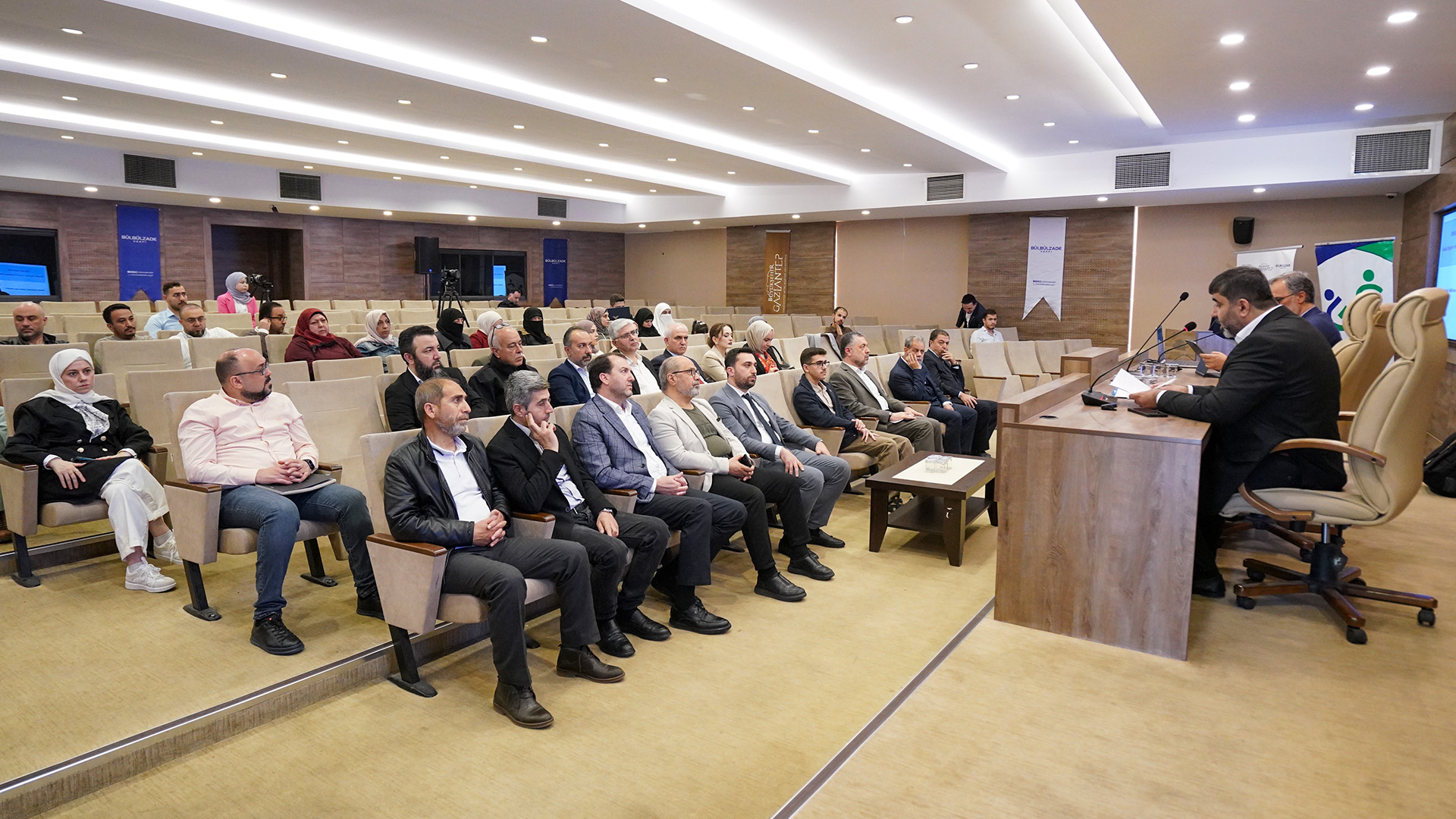


While the reconstruction of Syria was discussed at the 14th Common Future Meeting held in Gaziantep, the brain drain taking place on the ground and the adaptation problems experienced by young people marked the summit.
The 14th Common Future Meeting, implemented by the Migration Services Center under the coordination of the Gaziantep Governorship, Metropolitan Municipality, and Bülbülzade Foundation, brought together Turkish and Syrian opinion leaders on May 9 at the municipality’s Çetin Emeç Meeting Hall. In this year’s session of the program, organized with the aim of strengthening the culture of unity between Türkiye and Syria, realities experienced in the field were voiced loudly beyond protocol speeches.
THE WILL FOR SOLUTIONS AND HOPE WERE KEPT ALIVE
At the meeting attended by Migration Services Center Coordinator Remzi Yılmaz, Gaziantep Metropolitan Municipality Gazikültür Inc. General Manager Prof. Dr. Halil İbrahim Yakar, President of the Gaziantep Syrian Community Mustafa El Hüseyin, and many opinion leaders, the loss of qualified human resources to Europe and the deep cultural conflicts experienced by Syrian youth raised in Türkiye in their own country were discussed in all aspects. Despite all these difficulties and the heavy picture drawn, the will for solutions and hope were constantly kept alive in the hall. While it was emphasized that a common future could not be built with pessimism, the main philosophy of the meeting became the belief that Syria’s bright tomorrow could only be shaped by an educated and founding generation blended with the richness of both cultures.
IF ISTANBUL FALLS, ALEPPO WILL REBUILD IT
Speaking during the opening speeches, Bülbülzade Foundation President Turgay Aldemir drew attention to the enormous scale of the activities carried out by civil society organizations in Syria. Stating that the annual service planning of civil society organizations in the region had reached 157 million dollars, Aldemir emphasized historical ties and said: “The elders used to say, ‘If Istanbul falls, Aleppo will rebuild it. If Aleppo falls, Anatolia will rebuild it. If the whole world falls into hardship, these lands will once again become the source.’”
Aldemir also expressed his disappointment over the loss of trained human resources due to bureaucratic obstacles. Pointing out that brilliant young minds and specialists were being lost to Western countries, Aldemir painted a grim picture by saying: “At the moment, Germany’s healthcare system is in the hands of Syrian medical doctors. When they go there, the Germans beg us not to pull them back and offer us money. They all left from here. We could not grant equivalency.”
MIGRATION IS LIKE TRANSBOUNDARY WATERS
The main speaker of the program, Prof. Dr. İbrahim Altan, approached the phenomenon of migration from a different perspective in his presentation titled “Youth, Values, and the New Language of Civil Society.” Saying that “Migration is like transboundary waters,” Altan stated that these waters carry the resources of one country to another and that great benefit could be achieved if seen as an opportunity.
Arguing that the expectations of the new generation had changed, Altan stated that civil society needed to update its language. Emphasizing that young people want to be included in decision-making mechanisms, Altan said: “What do young people want from us? First, they want to be listened to. They want to be addressed and acknowledged by us, the elders.” He thus demanded greater transparency from traditional structures.
Altan also referred in his presentation to the initiative shown by a 12-year-old Syrian boy who stopped traffic to make way for an ambulance, pointing out the great value such individual acts add to relations between societies.
THE “YOU ARE TRAITORS” CONFLICT
During the discussion section of the meeting, Syrian academics, students, and civil society representatives voiced the current crises experienced on the ground. The observations shared by university student Fatma Zehra regarding the integration of young people had a major impact in the hall.
Pointing out the growing cultural gap between Syrian youth raised in Türkiye and those who remained in Syria, Zehra said: “Children who were born and raised here no longer find common ground when they go to Syria. Young people going to Syria encounter ideas such as: ‘You grew up in Türkiye, you are rich, we stayed here and defended our homeland. You are traitors.’ Problems are arising among the children.”
With these words, she drew attention to an approaching sociological danger.
CIVIL SOCIETY MUST TAKE MORE INITIATIVE
One of the most remarkable speeches of the meeting was delivered by university student Faysal, whose father is a pharmacist in Damascus and who brought great pride by being accepted to Harvard University.
Presenting a highly strategic analysis regarding the priorities of civil society in Syria, the young student pointed out that nearly 15 million people remaining in Syria had lived completely isolated from the technological, social, and economic developments in the world for 14 years. Stating that this disconnected population had no opportunity to build the future and that the Syrian government also lacked the resources to remove this sociological wreckage, Faysal emphasized that civil society organizations urgently needed to focus on this area.
The young student also criticized the process of international capital returning to the country and said: “Qatari or American companies sign agreements, but they do not return due to security concerns. Civil society leaders need to take initiative and ensure that people put their hands under the stone,” calling on the audience to shoulder a historic responsibility.
INJUSTICES CAUSE DEEP SUFFERING IN SOCIETY
Arabic teacher Adil Çavuş, who spoke at the meeting, described in striking language the grievances experienced at border crossings and within the education system.
Çavuş criticized the meaningless situation in which Syrians who had obtained citizenship could cross to the other side of the border every day with ease, while other members of the same family who had not obtained citizenship had been unable to visit their homeland for years, and called on the Ministry of Interior to solve this issue.
Çavuş also drew attention to the high costs in education, describing it as a major injustice that Syrian youth born and raised in Türkiye were treated the same as foreign students arriving from the other side of the world. Reminding the audience that these young people share the same living conditions as Turkish citizens, Çavuş demanded a special discounted status for Syrian students regarding university tuition fees.
Stating that no progress had been made despite ten months passing since the steps promised last July, Çavuş said that this situation was causing deep suffering within society and called for an urgent end to the dramas experienced by patients and separated families.